Agnus Dei | Francisco de Zurbarán | 1640
About the artwork:
Francisco de Zurbarán’s Agnus Dei (c. 1640) is a hauntingly simple yet emotionally powerful painting that depicts a lamb lying on a slab, its legs bound, its head gently resting on its side. With no background distractions, Zurbarán uses stark lighting and deep shadows to draw our full attention to the animal’s soft texture and serene expression. The lamb is not just an animal—it is a symbol of Christ as the sacrificial “Lamb of God,” embodying innocence, surrender, and divine suffering. The silence of the scene intensifies its impact; there is no blood, no violence—just the quiet inevitability of sacrifice. Through this restrained composition, Zurbarán transforms a still life into a profound meditation on death, purity, and spiritual redemption.
Product Information
Product Information
Shipping & Returns
Shipping & Returns


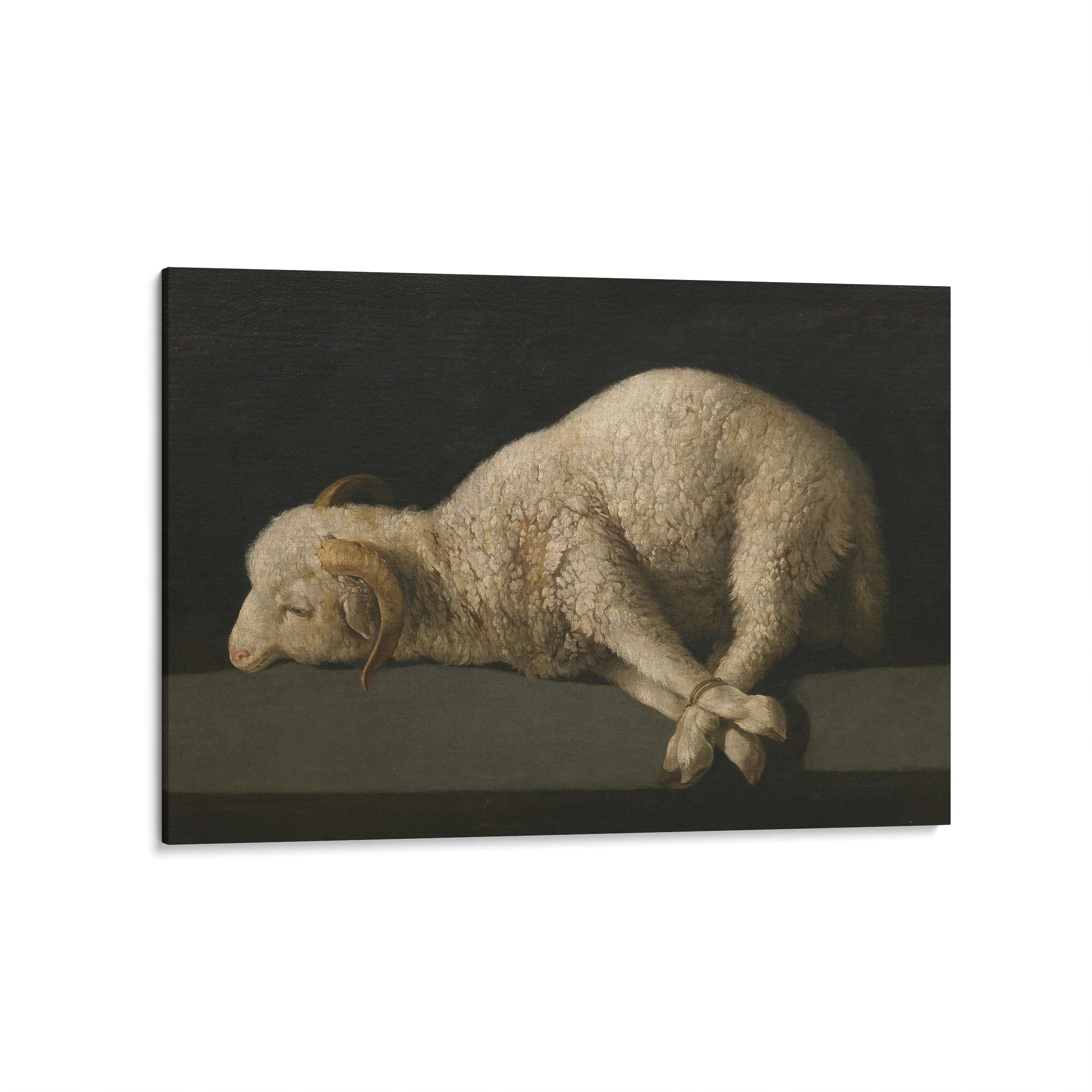


Agnus Dei | Francisco de Zurbarán | 1640
Agnus Dei | Francisco de Zurbarán | 1640
About the artwork:
Francisco de Zurbarán’s Agnus Dei (c. 1640) is a hauntingly simple yet emotionally powerful painting that depicts a lamb lying on a slab, its legs bound, its head gently resting on its side. With no background distractions, Zurbarán uses stark lighting and deep shadows to draw our full attention to the animal’s soft texture and serene expression. The lamb is not just an animal—it is a symbol of Christ as the sacrificial “Lamb of God,” embodying innocence, surrender, and divine suffering. The silence of the scene intensifies its impact; there is no blood, no violence—just the quiet inevitability of sacrifice. Through this restrained composition, Zurbarán transforms a still life into a profound meditation on death, purity, and spiritual redemption.
Original: $297.82
-70%$297.82
$89.35Product Information
Product Information
Shipping & Returns
Shipping & Returns
Description
About the artwork:
Francisco de Zurbarán’s Agnus Dei (c. 1640) is a hauntingly simple yet emotionally powerful painting that depicts a lamb lying on a slab, its legs bound, its head gently resting on its side. With no background distractions, Zurbarán uses stark lighting and deep shadows to draw our full attention to the animal’s soft texture and serene expression. The lamb is not just an animal—it is a symbol of Christ as the sacrificial “Lamb of God,” embodying innocence, surrender, and divine suffering. The silence of the scene intensifies its impact; there is no blood, no violence—just the quiet inevitability of sacrifice. Through this restrained composition, Zurbarán transforms a still life into a profound meditation on death, purity, and spiritual redemption.