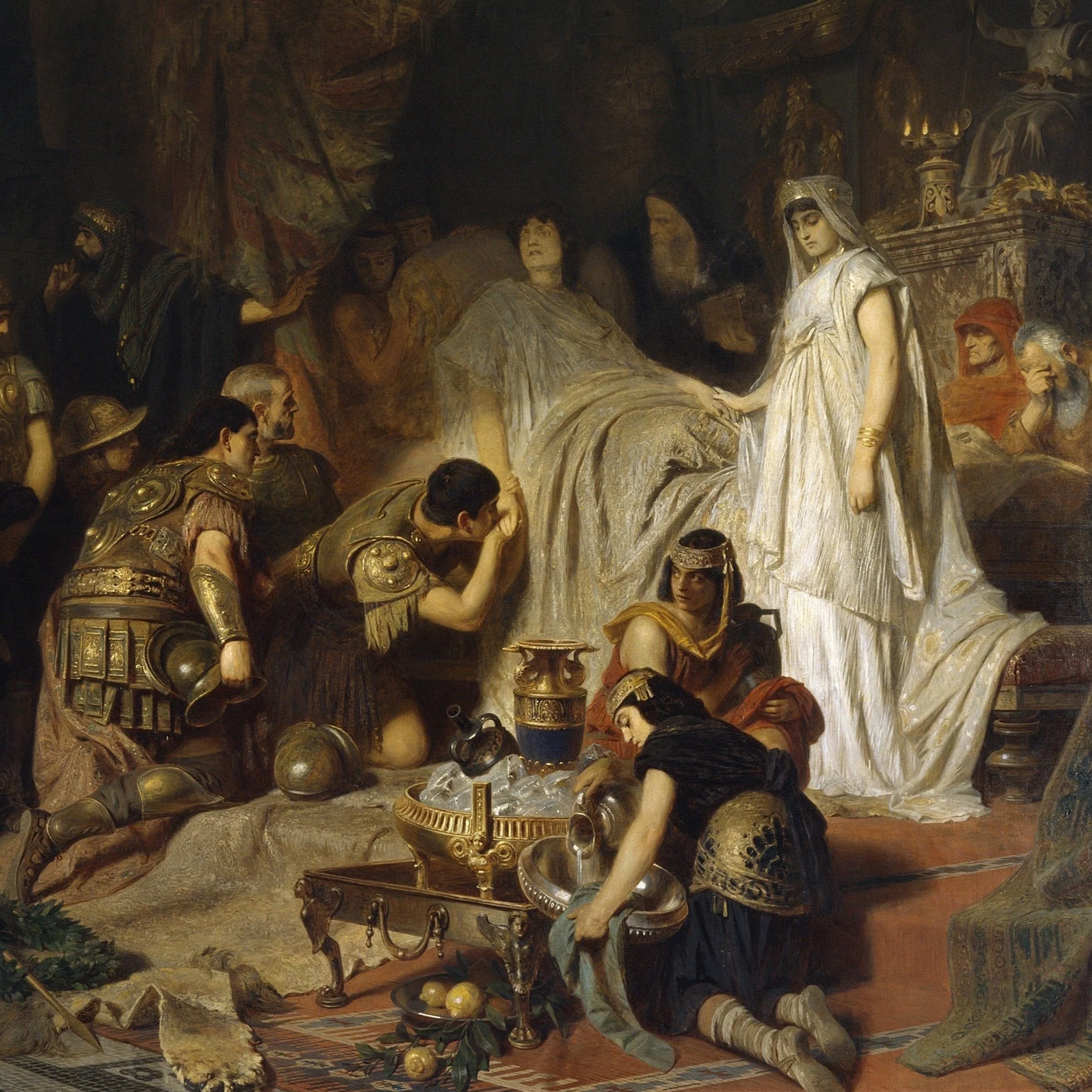
Hellas | Vasily Polenov | 1880-90
About the artwork:
In Hellas (ca. 1880–1890), Vasily Polenov presents an idealized vision of ancient Greece, merging classical architecture, sculpture, and landscape into a serene and harmonious composition. A Doric temple rises on the left, casting long shadows, while a lone female figure in a white tunic stands at its steps, gazing in silence. To the right, a marble statue—reminiscent of the Venus de Milo—faces the viewer, set against the dark sea and sunlit mountains in the background. Rather than depicting a specific historical site, Polenov constructs a poetic tableau that distills the West’s romanticized image of Greece: ordered, eternal, and bathed in Mediterranean light. His work reflects not archaeological precision, but a deep nostalgia for a culture imagined as the cradle of harmony and beauty. The scene is timeless—not ruined, but preserved—as if the past continues to exist in a moment of perfect stillness, inviting viewers to contemplate a civilization that still resonates in our collective memory.
Product Information
Product Information
Shipping & Returns
Shipping & Returns

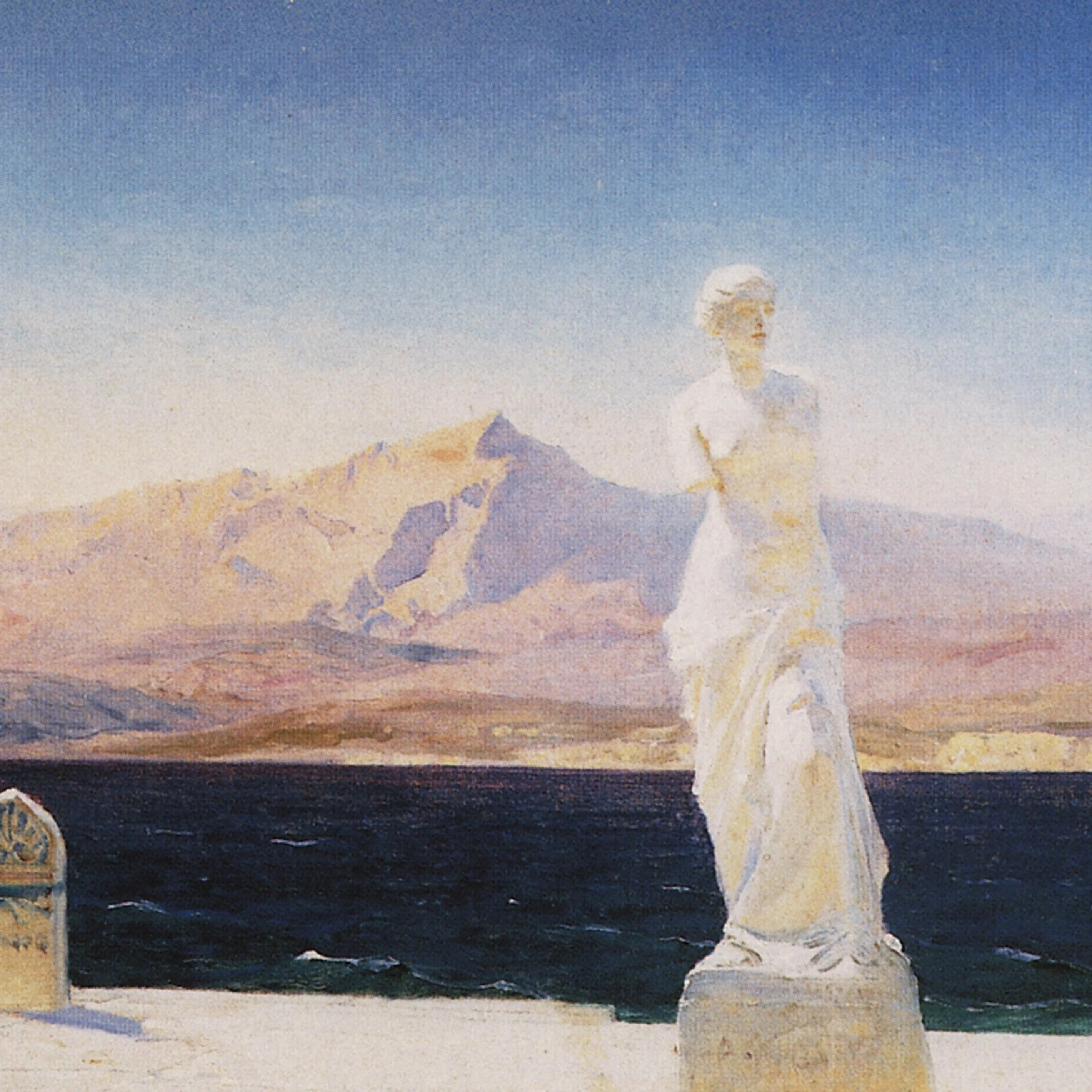


Hellas | Vasily Polenov | 1880-90
Hellas | Vasily Polenov | 1880-90
About the artwork:
In Hellas (ca. 1880–1890), Vasily Polenov presents an idealized vision of ancient Greece, merging classical architecture, sculpture, and landscape into a serene and harmonious composition. A Doric temple rises on the left, casting long shadows, while a lone female figure in a white tunic stands at its steps, gazing in silence. To the right, a marble statue—reminiscent of the Venus de Milo—faces the viewer, set against the dark sea and sunlit mountains in the background. Rather than depicting a specific historical site, Polenov constructs a poetic tableau that distills the West’s romanticized image of Greece: ordered, eternal, and bathed in Mediterranean light. His work reflects not archaeological precision, but a deep nostalgia for a culture imagined as the cradle of harmony and beauty. The scene is timeless—not ruined, but preserved—as if the past continues to exist in a moment of perfect stillness, inviting viewers to contemplate a civilization that still resonates in our collective memory.
Original: $297.82
-70%$297.82
$89.35Product Information
Product Information
Shipping & Returns
Shipping & Returns
Description
About the artwork:
In Hellas (ca. 1880–1890), Vasily Polenov presents an idealized vision of ancient Greece, merging classical architecture, sculpture, and landscape into a serene and harmonious composition. A Doric temple rises on the left, casting long shadows, while a lone female figure in a white tunic stands at its steps, gazing in silence. To the right, a marble statue—reminiscent of the Venus de Milo—faces the viewer, set against the dark sea and sunlit mountains in the background. Rather than depicting a specific historical site, Polenov constructs a poetic tableau that distills the West’s romanticized image of Greece: ordered, eternal, and bathed in Mediterranean light. His work reflects not archaeological precision, but a deep nostalgia for a culture imagined as the cradle of harmony and beauty. The scene is timeless—not ruined, but preserved—as if the past continues to exist in a moment of perfect stillness, inviting viewers to contemplate a civilization that still resonates in our collective memory.