✨ New Arrivals Just Dropped!Explore
HomeStore

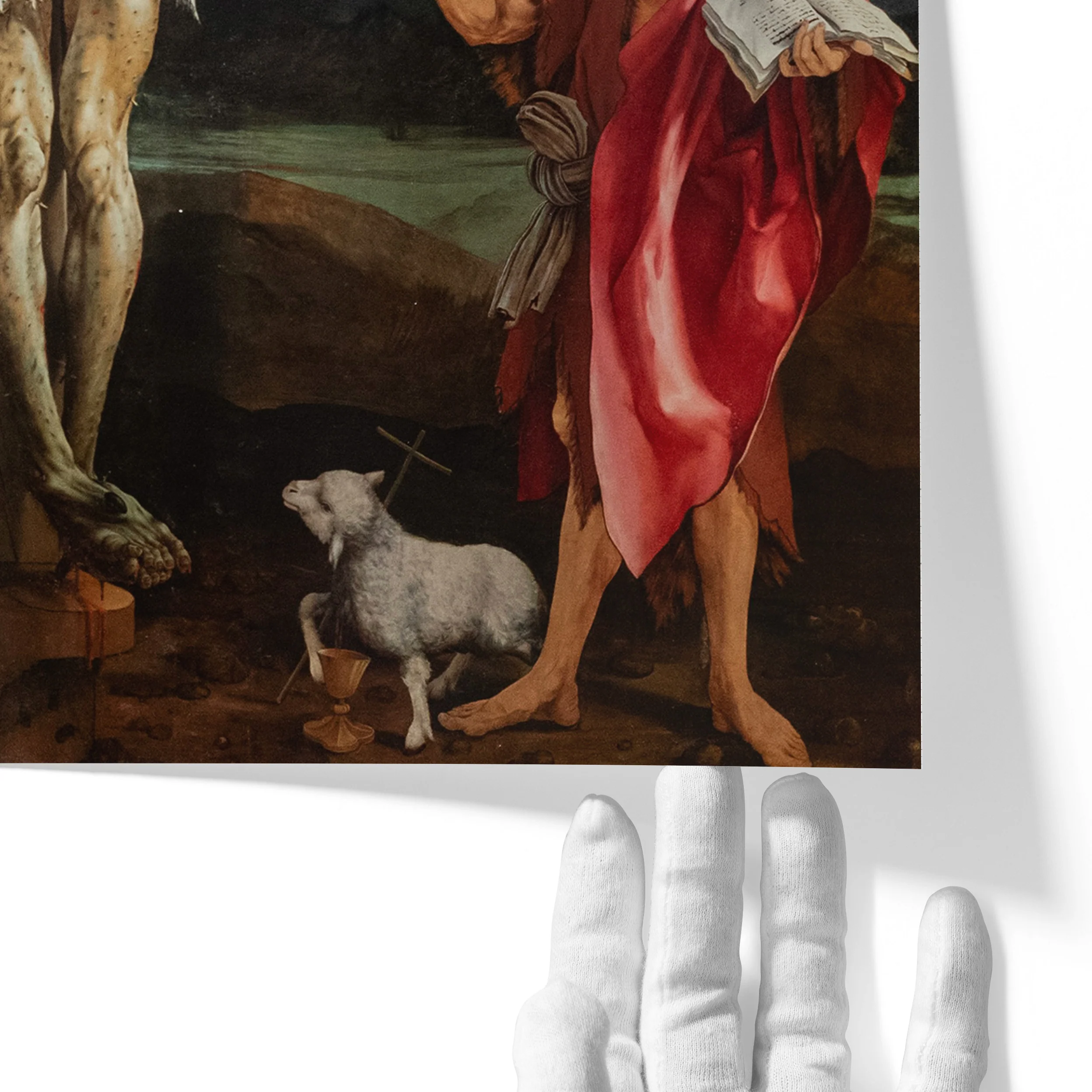
Isenheim Altarpiece: The Crucifixion | Matthias Grünewald | c. 1512–16

Product image 1
Product image 2
Product image 3
Product image 4
Product image 5
Product image 6
Product image 7
Product image 8

Isenheim Altarpiece: The Crucifixion | Matthias Grünewald | c. 1512–16

Isenheim Altarpiece: The Crucifixion | Matthias Grünewald | c. 1512–16

About the artwork:

The central panel of the Isenheim Altarpiece presents one of the most harrowing depictions of the Crucifixion in Western art. Matthias Grünewald transforms the familiar image of Christ on the cross into a vision of raw human agony: his body is covered in open sores, his skin has turned a sickly green, and his fingers curl in unbearable tension. This grotesque realism reflects the suffering of patients in the Antonite hospital for whom the altarpiece was originally made, many of whom endured ergotism, a disease that caused convulsions and gangrene. To them, Christ’s decaying flesh was not blasphemy but empathy — a divine being who suffered as they did. Around him, the sorrow of Mary, Mary Magdalene, and John the Baptist contrasts with the stillness of the dark background, emphasizing a world where faith and pain coexist in haunting silence.

Select Select Size
Select Frame Options
From $137.96

Original: $459.85

-70%
Isenheim Altarpiece: The Crucifixion | Matthias Grünewald | c. 1512–16

$459.85

$137.96

Product Information

Shipping & Returns

Description

About the artwork:
The central panel of the Isenheim Altarpiece presents one of the most harrowing depictions of the Crucifixion in Western art. Matthias Grünewald transforms the familiar image of Christ on the cross into a vision of raw human agony: his body is covered in open sores, his skin has turned a sickly green, and his fingers curl in unbearable tension. This grotesque realism reflects the suffering of patients in the Antonite hospital for whom the altarpiece was originally made, many of whom endured ergotism, a disease that caused convulsions and gangrene. To them, Christ’s decaying flesh was not blasphemy but empathy — a divine being who suffered as they did. Around him, the sorrow of Mary, Mary Magdalene, and John the Baptist contrasts with the stillness of the dark background, emphasizing a world where faith and pain coexist in haunting silence.