Orpheus Leading Eurydice from the Underworld | Jean-Baptiste-Camille Corot | 1861
About the artwork:
Orpheus Leading Eurydice from the Underworld (1861) by Jean-Baptiste-Camille Corot is a hauntingly poetic interpretation of the Greek myth, capturing the fragile moment when Orpheus guides his wife Eurydice back to the world of the living. Bathed in a soft, almost dreamlike light, the painting emphasizes mood over detail, with ghostly trees and a hazy landscape enveloping the figures in melancholy. Orpheus walks ahead, clutching his lyre, while Eurydice follows behind—her pale, delicate form nearly dissolving into the shadows, symbolizing the transience of life and the nearness of loss. Corot’s restrained palette and gentle brushwork evoke silence, grief, and inevitability, as if the painting itself mourns the doomed lovers. Rather than focusing on narrative climax, Corot captures the emotional tension of the in-between—a quiet moment on the edge of hope and tragedy.
Product Information
Product Information
Shipping & Returns
Shipping & Returns


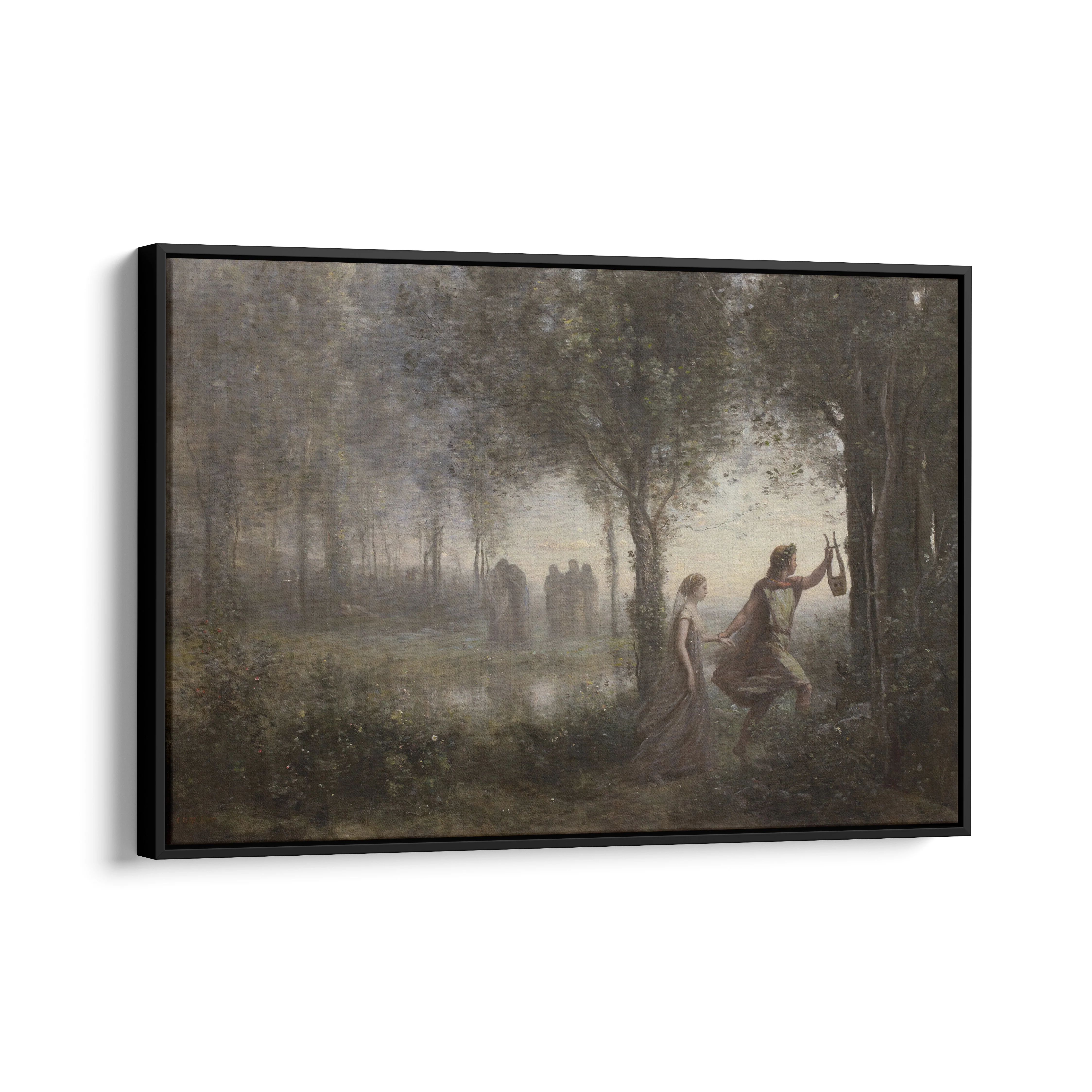

Orpheus Leading Eurydice from the Underworld | Jean-Baptiste-Camille Corot | 1861
Orpheus Leading Eurydice from the Underworld | Jean-Baptiste-Camille Corot | 1861
About the artwork:
Orpheus Leading Eurydice from the Underworld (1861) by Jean-Baptiste-Camille Corot is a hauntingly poetic interpretation of the Greek myth, capturing the fragile moment when Orpheus guides his wife Eurydice back to the world of the living. Bathed in a soft, almost dreamlike light, the painting emphasizes mood over detail, with ghostly trees and a hazy landscape enveloping the figures in melancholy. Orpheus walks ahead, clutching his lyre, while Eurydice follows behind—her pale, delicate form nearly dissolving into the shadows, symbolizing the transience of life and the nearness of loss. Corot’s restrained palette and gentle brushwork evoke silence, grief, and inevitability, as if the painting itself mourns the doomed lovers. Rather than focusing on narrative climax, Corot captures the emotional tension of the in-between—a quiet moment on the edge of hope and tragedy.
Original: $297.82
-70%$297.82
$89.35Product Information
Product Information
Shipping & Returns
Shipping & Returns
Description
About the artwork:
Orpheus Leading Eurydice from the Underworld (1861) by Jean-Baptiste-Camille Corot is a hauntingly poetic interpretation of the Greek myth, capturing the fragile moment when Orpheus guides his wife Eurydice back to the world of the living. Bathed in a soft, almost dreamlike light, the painting emphasizes mood over detail, with ghostly trees and a hazy landscape enveloping the figures in melancholy. Orpheus walks ahead, clutching his lyre, while Eurydice follows behind—her pale, delicate form nearly dissolving into the shadows, symbolizing the transience of life and the nearness of loss. Corot’s restrained palette and gentle brushwork evoke silence, grief, and inevitability, as if the painting itself mourns the doomed lovers. Rather than focusing on narrative climax, Corot captures the emotional tension of the in-between—a quiet moment on the edge of hope and tragedy.