Self-Portrait with Beret and Turned-Up Collar | Rembrandt | 1659
About the artwork:
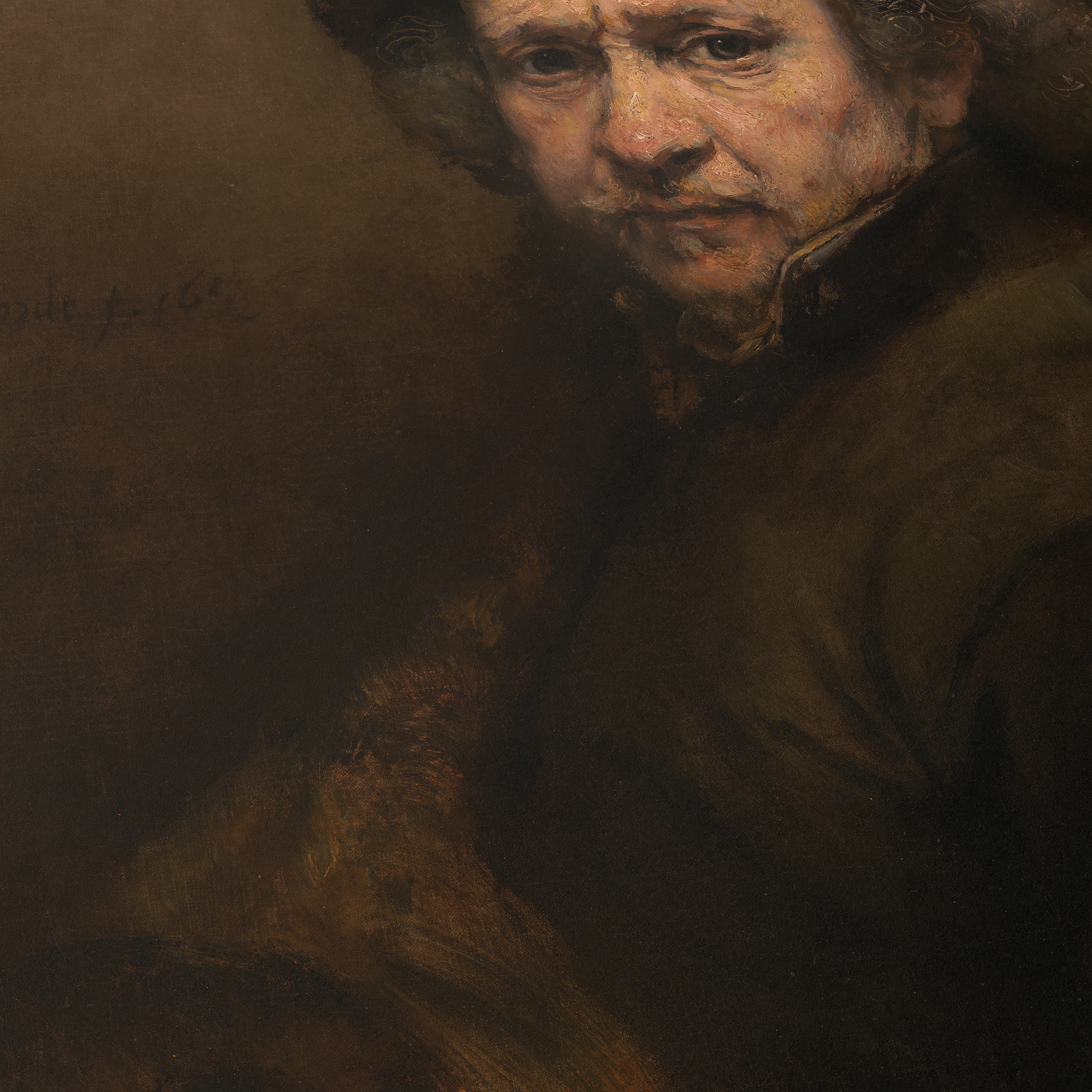
This haunting self-portrait, painted just ten years before Rembrandt’s death, is one of the most psychologically profound images in Western art. With a dark beret casting a shadow over his forehead and a heavy coat turned up around his neck, Rembrandt presents himself with dignity—yet the years of loss, financial ruin, and personal tragedy are etched into the worn features of his face. His gaze meets ours directly, steady and contemplative, inviting the viewer into a silent confrontation with mortality.
By 1659, Rembrandt had lost nearly everything: his wife Saskia, his fortune, and even his home. Yet in this portrait, he does not seek pity. The impasto brushwork—especially in the face—reveals a raw texture that mirrors the emotional depth of the sitter. It is a painting not of vanity, but of resilience. Rembrandt’s use of light and shadow here is not merely technical—it becomes a metaphor for the fragile boundary between survival and surrender.
Product Information
Product Information
Shipping & Returns
Shipping & Returns




Self-Portrait with Beret and Turned-Up Collar | Rembrandt | 1659
Self-Portrait with Beret and Turned-Up Collar | Rembrandt | 1659
About the artwork:
This haunting self-portrait, painted just ten years before Rembrandt’s death, is one of the most psychologically profound images in Western art. With a dark beret casting a shadow over his forehead and a heavy coat turned up around his neck, Rembrandt presents himself with dignity—yet the years of loss, financial ruin, and personal tragedy are etched into the worn features of his face. His gaze meets ours directly, steady and contemplative, inviting the viewer into a silent confrontation with mortality.
By 1659, Rembrandt had lost nearly everything: his wife Saskia, his fortune, and even his home. Yet in this portrait, he does not seek pity. The impasto brushwork—especially in the face—reveals a raw texture that mirrors the emotional depth of the sitter. It is a painting not of vanity, but of resilience. Rembrandt’s use of light and shadow here is not merely technical—it becomes a metaphor for the fragile boundary between survival and surrender.
Original: $297.82
-70%$297.82
$89.35Product Information
Product Information
Shipping & Returns
Shipping & Returns
Description
About the artwork:
This haunting self-portrait, painted just ten years before Rembrandt’s death, is one of the most psychologically profound images in Western art. With a dark beret casting a shadow over his forehead and a heavy coat turned up around his neck, Rembrandt presents himself with dignity—yet the years of loss, financial ruin, and personal tragedy are etched into the worn features of his face. His gaze meets ours directly, steady and contemplative, inviting the viewer into a silent confrontation with mortality.
By 1659, Rembrandt had lost nearly everything: his wife Saskia, his fortune, and even his home. Yet in this portrait, he does not seek pity. The impasto brushwork—especially in the face—reveals a raw texture that mirrors the emotional depth of the sitter. It is a painting not of vanity, but of resilience. Rembrandt’s use of light and shadow here is not merely technical—it becomes a metaphor for the fragile boundary between survival and surrender.