Self-Portrait with Plumed Beret | Rembrandt | 1629
About the artwork:
In this early work, Rembrandt portrays himself not as a humble student, but as a figure of flair and theatricality. Donning a lavish plumed beret and a costume reminiscent of historical or aristocratic garb, he adopts the persona of a dashing cavalier. The light grazes his cheek and curls, casting much of his face in partial shadow—creating a sense of mystery and depth that would become a hallmark of his mature style.
At just 23 years old, Rembrandt was already experimenting with self-representation as performance. Rather than striving for realism, this painting is an imaginative exercise, perhaps inspired by the “tronie” tradition—a study of character and expression rather than a formal portrait. Here, Rembrandt is not presenting who he is, but who he could be: a master of drama, a man of the stage, an artist in control of both identity and illusion.
Product Information
Product Information
Shipping & Returns
Shipping & Returns


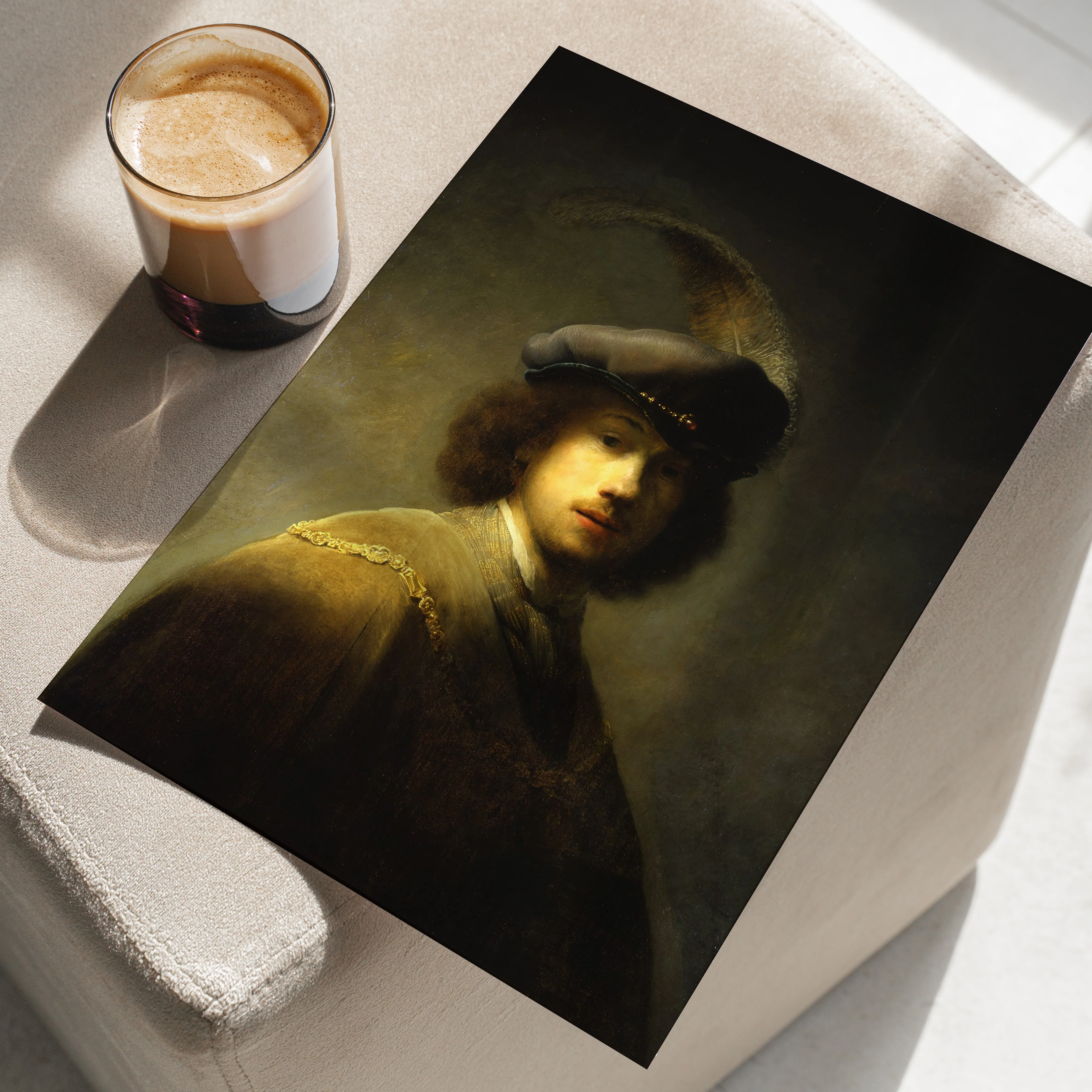


Self-Portrait with Plumed Beret | Rembrandt | 1629
Self-Portrait with Plumed Beret | Rembrandt | 1629
About the artwork:
In this early work, Rembrandt portrays himself not as a humble student, but as a figure of flair and theatricality. Donning a lavish plumed beret and a costume reminiscent of historical or aristocratic garb, he adopts the persona of a dashing cavalier. The light grazes his cheek and curls, casting much of his face in partial shadow—creating a sense of mystery and depth that would become a hallmark of his mature style.
At just 23 years old, Rembrandt was already experimenting with self-representation as performance. Rather than striving for realism, this painting is an imaginative exercise, perhaps inspired by the “tronie” tradition—a study of character and expression rather than a formal portrait. Here, Rembrandt is not presenting who he is, but who he could be: a master of drama, a man of the stage, an artist in control of both identity and illusion.
Original: $297.82
-70%$297.82
$89.35Product Information
Product Information
Shipping & Returns
Shipping & Returns
Description
About the artwork:
In this early work, Rembrandt portrays himself not as a humble student, but as a figure of flair and theatricality. Donning a lavish plumed beret and a costume reminiscent of historical or aristocratic garb, he adopts the persona of a dashing cavalier. The light grazes his cheek and curls, casting much of his face in partial shadow—creating a sense of mystery and depth that would become a hallmark of his mature style.
At just 23 years old, Rembrandt was already experimenting with self-representation as performance. Rather than striving for realism, this painting is an imaginative exercise, perhaps inspired by the “tronie” tradition—a study of character and expression rather than a formal portrait. Here, Rembrandt is not presenting who he is, but who he could be: a master of drama, a man of the stage, an artist in control of both identity and illusion.