✨ New Arrivals Just Dropped!Explore
HomeStore

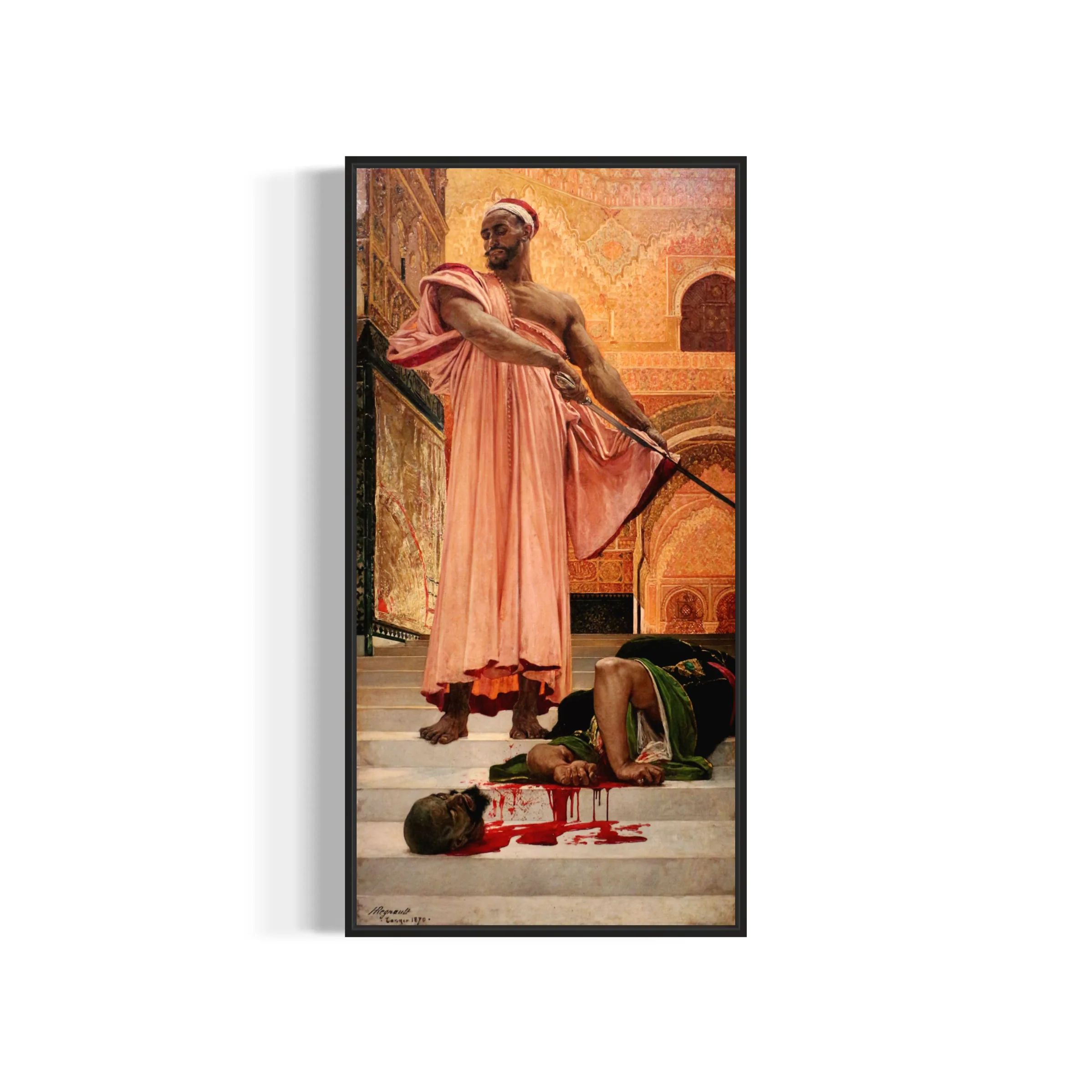
Summary Execution under the Moorish Kings of Granada | Henri Regnault | 1870

Product image 1
Product image 2
Product image 3
Product image 4
Product image 5
Product image 6
Product image 7

Summary Execution under the Moorish Kings of Granada | Henri Regnault | 1870

Summary Execution under the Moorish Kings of Granada | Henri Regnault | 1870

About the artwork:

Henri Regnault’s Summary Execution under the Moorish Kings of Granada (1870) is a striking example of 19th-century French Orientalism, combining fascination with exotic settings and a taste for theatrical violence. The canvas shows an executioner calmly cleaning his curved scimitar after a decapitation, while the victim’s body and blood stain the marble steps of an Alhambra-inspired interior. By choosing a low viewpoint, Regnault forces the viewer to look up at the almost life-size figure, giving him an imposing presence. The contrast between the ornate Moorish architecture and the brutal act heightens the sense of shock, while details like the vivid red of the blood against the green of the robes underline his mastery of realism. The painting is not just a display of technical skill but also a reflection of the 19th-century European fascination with an imagined, often violent “Orient,” making it both unsettling and captivating.

Select Select Size
Select Frame Options
From $151.31

Original: $504.35

-70%
Summary Execution under the Moorish Kings of Granada | Henri Regnault | 1870

$504.35

$151.31

Product Information

Shipping & Returns

Description

About the artwork:
Henri Regnault’s Summary Execution under the Moorish Kings of Granada (1870) is a striking example of 19th-century French Orientalism, combining fascination with exotic settings and a taste for theatrical violence. The canvas shows an executioner calmly cleaning his curved scimitar after a decapitation, while the victim’s body and blood stain the marble steps of an Alhambra-inspired interior. By choosing a low viewpoint, Regnault forces the viewer to look up at the almost life-size figure, giving him an imposing presence. The contrast between the ornate Moorish architecture and the brutal act heightens the sense of shock, while details like the vivid red of the blood against the green of the robes underline his mastery of realism. The painting is not just a display of technical skill but also a reflection of the 19th-century European fascination with an imagined, often violent “Orient,” making it both unsettling and captivating.