The Ambassadors | Hans Holbein the Younger | 1533
About the artwork:
Hans Holbein the Younger's The Ambassadors (1533) is a masterful double portrait that embodies the intellectual, political, and spiritual tensions of the 16th century. Depicting Jean de Dinteville and Georges de Selve—two French diplomats—the painting surrounds them with a rich array of scientific instruments, globes, musical instruments, and books, symbolizing the Renaissance ideals of humanism, exploration, and scholarly pursuit. However, at the center of this worldly celebration lies a stark memento mori: an anamorphic skull that appears distorted unless viewed from an oblique angle, reminding viewers of death’s inevitability and the transience of earthly achievements. The partially hidden crucifix in the upper left corner further adds a layer of spiritual reflection, suggesting the tension between religious faith and secular knowledge. Through this intricate composition, Holbein presents a visual puzzle that challenges the viewer to reflect on mortality, identity, and the complex intersections of art, science, and religion in the early modern world.
Product Information
Product Information
Shipping & Returns
Shipping & Returns


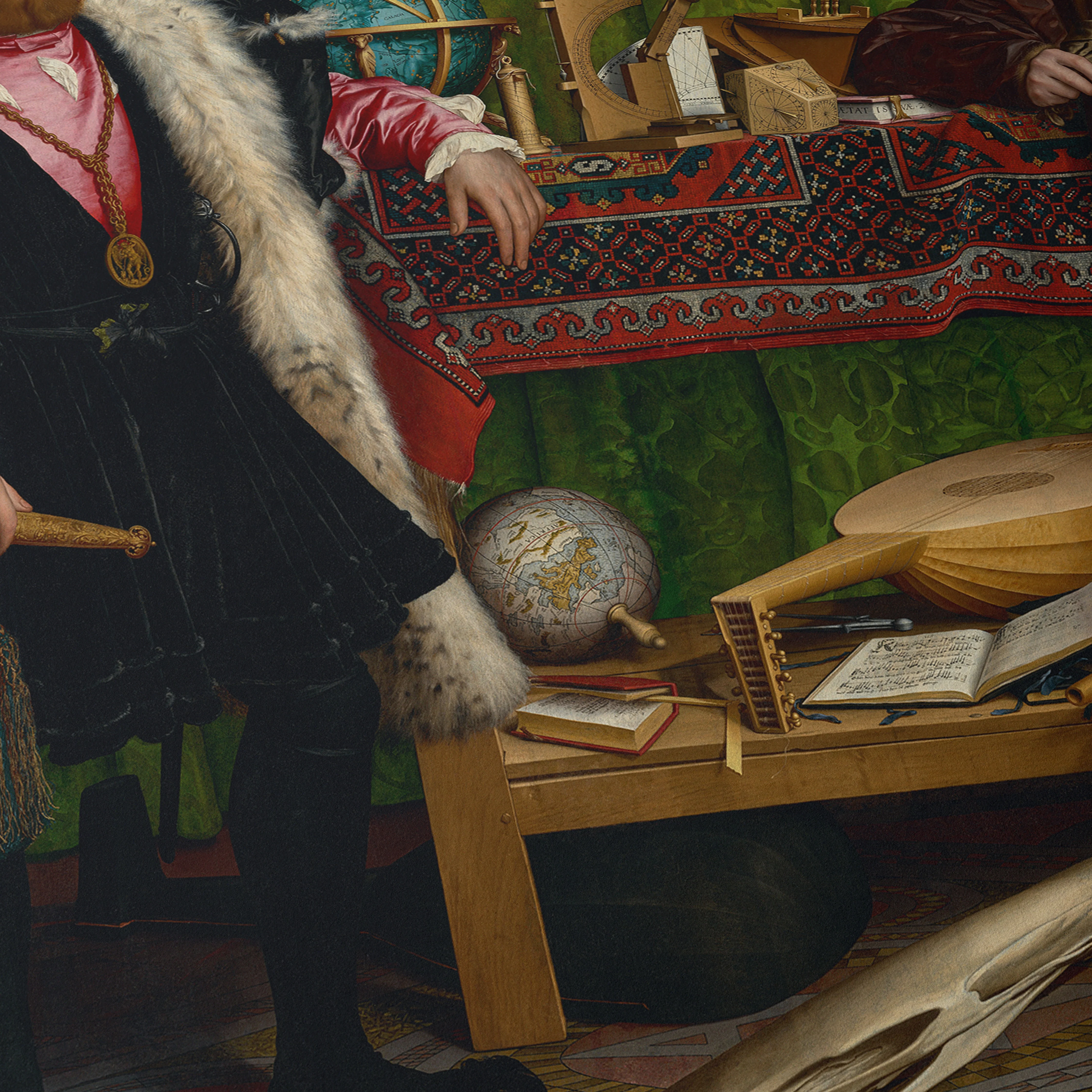


The Ambassadors | Hans Holbein the Younger | 1533
The Ambassadors | Hans Holbein the Younger | 1533
About the artwork:
Hans Holbein the Younger's The Ambassadors (1533) is a masterful double portrait that embodies the intellectual, political, and spiritual tensions of the 16th century. Depicting Jean de Dinteville and Georges de Selve—two French diplomats—the painting surrounds them with a rich array of scientific instruments, globes, musical instruments, and books, symbolizing the Renaissance ideals of humanism, exploration, and scholarly pursuit. However, at the center of this worldly celebration lies a stark memento mori: an anamorphic skull that appears distorted unless viewed from an oblique angle, reminding viewers of death’s inevitability and the transience of earthly achievements. The partially hidden crucifix in the upper left corner further adds a layer of spiritual reflection, suggesting the tension between religious faith and secular knowledge. Through this intricate composition, Holbein presents a visual puzzle that challenges the viewer to reflect on mortality, identity, and the complex intersections of art, science, and religion in the early modern world.
Product Information
Product Information
Shipping & Returns
Shipping & Returns
Description
About the artwork:
Hans Holbein the Younger's The Ambassadors (1533) is a masterful double portrait that embodies the intellectual, political, and spiritual tensions of the 16th century. Depicting Jean de Dinteville and Georges de Selve—two French diplomats—the painting surrounds them with a rich array of scientific instruments, globes, musical instruments, and books, symbolizing the Renaissance ideals of humanism, exploration, and scholarly pursuit. However, at the center of this worldly celebration lies a stark memento mori: an anamorphic skull that appears distorted unless viewed from an oblique angle, reminding viewers of death’s inevitability and the transience of earthly achievements. The partially hidden crucifix in the upper left corner further adds a layer of spiritual reflection, suggesting the tension between religious faith and secular knowledge. Through this intricate composition, Holbein presents a visual puzzle that challenges the viewer to reflect on mortality, identity, and the complex intersections of art, science, and religion in the early modern world.