The Gardener | Giuseppe Arcimboldo | 1587
About the artwork:
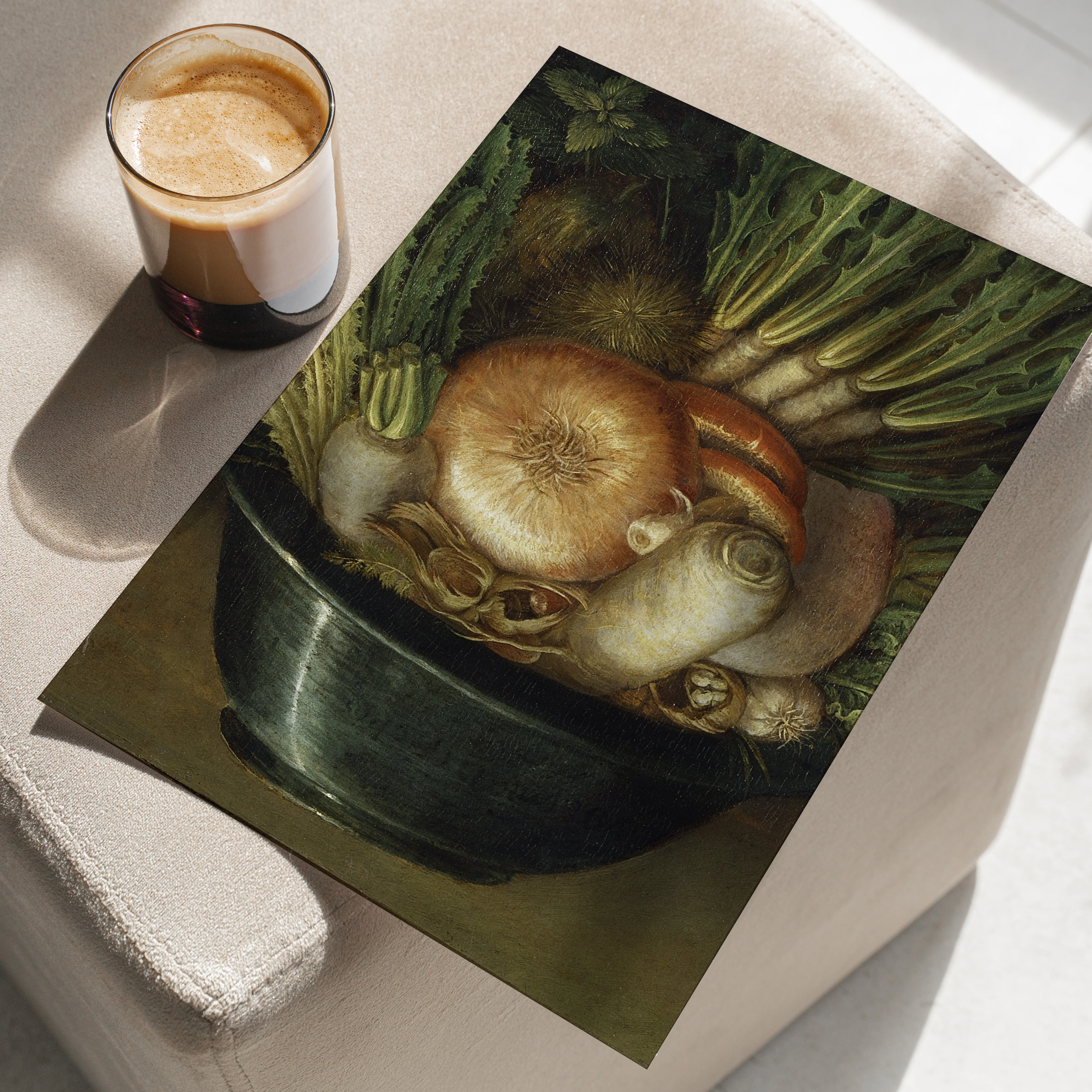
The Gardener by Giuseppe Arcimboldo is a clever and ambiguous double-image painting that at first glance appears to be a bowl brimming with vegetables—radishes, onions, mushrooms, and leafy greens. However, when the canvas is turned upside down, it reveals a human face composed of the same elements, complete with a sly expression and leafy hair. This visual pun exemplifies Arcimboldo’s fascination with perception, transformation, and the interconnectedness between humanity and nature. More than a whimsical trick, The Gardener challenges the viewer to question what is seen versus what is known, playing with Renaissance themes of illusion, the senses, and the mutable boundaries between man and the natural world. Its title hints at cultivation and care, suggesting that just as a gardener tends to plants, so too does nature shape human identity—an idea well-aligned with the intellectual curiosity and symbolic complexity of Rudolf II’s court.
Product Information
Product Information
Shipping & Returns
Shipping & Returns




The Gardener | Giuseppe Arcimboldo | 1587
The Gardener | Giuseppe Arcimboldo | 1587
About the artwork:
The Gardener by Giuseppe Arcimboldo is a clever and ambiguous double-image painting that at first glance appears to be a bowl brimming with vegetables—radishes, onions, mushrooms, and leafy greens. However, when the canvas is turned upside down, it reveals a human face composed of the same elements, complete with a sly expression and leafy hair. This visual pun exemplifies Arcimboldo’s fascination with perception, transformation, and the interconnectedness between humanity and nature. More than a whimsical trick, The Gardener challenges the viewer to question what is seen versus what is known, playing with Renaissance themes of illusion, the senses, and the mutable boundaries between man and the natural world. Its title hints at cultivation and care, suggesting that just as a gardener tends to plants, so too does nature shape human identity—an idea well-aligned with the intellectual curiosity and symbolic complexity of Rudolf II’s court.
Original: $297.82
-70%$297.82
$89.35Product Information
Product Information
Shipping & Returns
Shipping & Returns
Description
About the artwork:
The Gardener by Giuseppe Arcimboldo is a clever and ambiguous double-image painting that at first glance appears to be a bowl brimming with vegetables—radishes, onions, mushrooms, and leafy greens. However, when the canvas is turned upside down, it reveals a human face composed of the same elements, complete with a sly expression and leafy hair. This visual pun exemplifies Arcimboldo’s fascination with perception, transformation, and the interconnectedness between humanity and nature. More than a whimsical trick, The Gardener challenges the viewer to question what is seen versus what is known, playing with Renaissance themes of illusion, the senses, and the mutable boundaries between man and the natural world. Its title hints at cultivation and care, suggesting that just as a gardener tends to plants, so too does nature shape human identity—an idea well-aligned with the intellectual curiosity and symbolic complexity of Rudolf II’s court.