The Laboratory | John Collier | 1895
About the artwork:
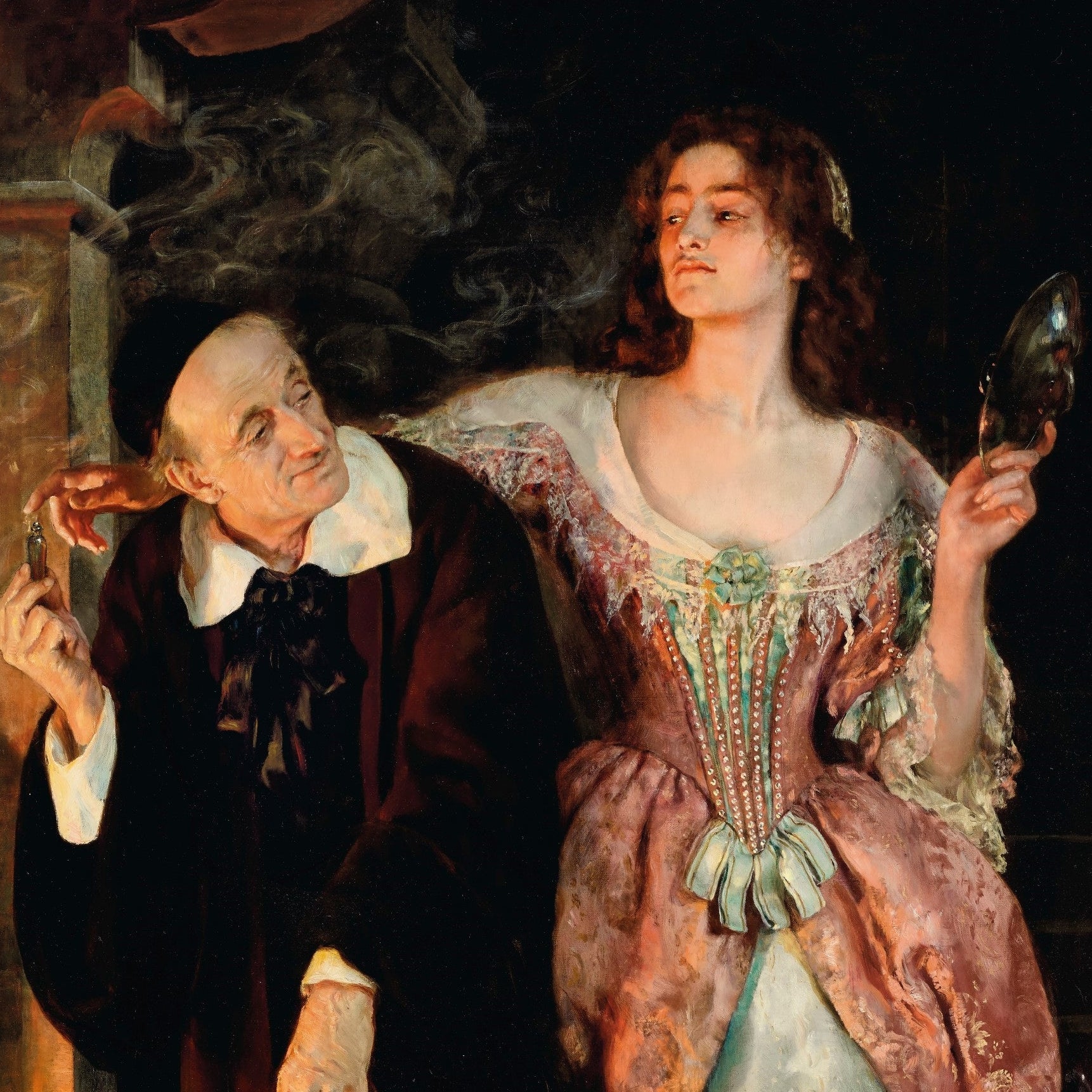
John Collier’s The Laboratory presents a carefully staged scene of revenge in which the apparent world of experiment and chemistry becomes a setting for moral corruption rather than scientific progress. Painted in 1895, the work belongs to Collier’s broader interest in narrative images often described as “problem pictures,” designed to provoke speculation about the characters and their motives, and this painting was associated with a sensational story of a woman preparing poison for her husband’s lover. What makes the image especially effective is Collier’s control of focus and atmosphere. The woman dominates the composition with a concentrated, almost ritual intensity, while the dim interior, glass vessels, and metallic reflections create a mood of danger and secrecy. Although Collier worked in a Pre Raphaelite influenced manner, here he uses that clarity not for ideal beauty alone, but to heighten tension and psychological ambiguity. The painting ultimately reflects late Victorian fascination with crime, desire, and the blurred boundary between knowledge and transgression.
Product Information
Product Information
Shipping & Returns
Shipping & Returns



The Laboratory | John Collier | 1895
The Laboratory | John Collier | 1895
About the artwork:
John Collier’s The Laboratory presents a carefully staged scene of revenge in which the apparent world of experiment and chemistry becomes a setting for moral corruption rather than scientific progress. Painted in 1895, the work belongs to Collier’s broader interest in narrative images often described as “problem pictures,” designed to provoke speculation about the characters and their motives, and this painting was associated with a sensational story of a woman preparing poison for her husband’s lover. What makes the image especially effective is Collier’s control of focus and atmosphere. The woman dominates the composition with a concentrated, almost ritual intensity, while the dim interior, glass vessels, and metallic reflections create a mood of danger and secrecy. Although Collier worked in a Pre Raphaelite influenced manner, here he uses that clarity not for ideal beauty alone, but to heighten tension and psychological ambiguity. The painting ultimately reflects late Victorian fascination with crime, desire, and the blurred boundary between knowledge and transgression.
Original: $297.82
-70%$297.82
$89.35Product Information
Product Information
Shipping & Returns
Shipping & Returns
Description
About the artwork:
John Collier’s The Laboratory presents a carefully staged scene of revenge in which the apparent world of experiment and chemistry becomes a setting for moral corruption rather than scientific progress. Painted in 1895, the work belongs to Collier’s broader interest in narrative images often described as “problem pictures,” designed to provoke speculation about the characters and their motives, and this painting was associated with a sensational story of a woman preparing poison for her husband’s lover. What makes the image especially effective is Collier’s control of focus and atmosphere. The woman dominates the composition with a concentrated, almost ritual intensity, while the dim interior, glass vessels, and metallic reflections create a mood of danger and secrecy. Although Collier worked in a Pre Raphaelite influenced manner, here he uses that clarity not for ideal beauty alone, but to heighten tension and psychological ambiguity. The painting ultimately reflects late Victorian fascination with crime, desire, and the blurred boundary between knowledge and transgression.