✨ New Arrivals Just Dropped!Explore
HomeStore

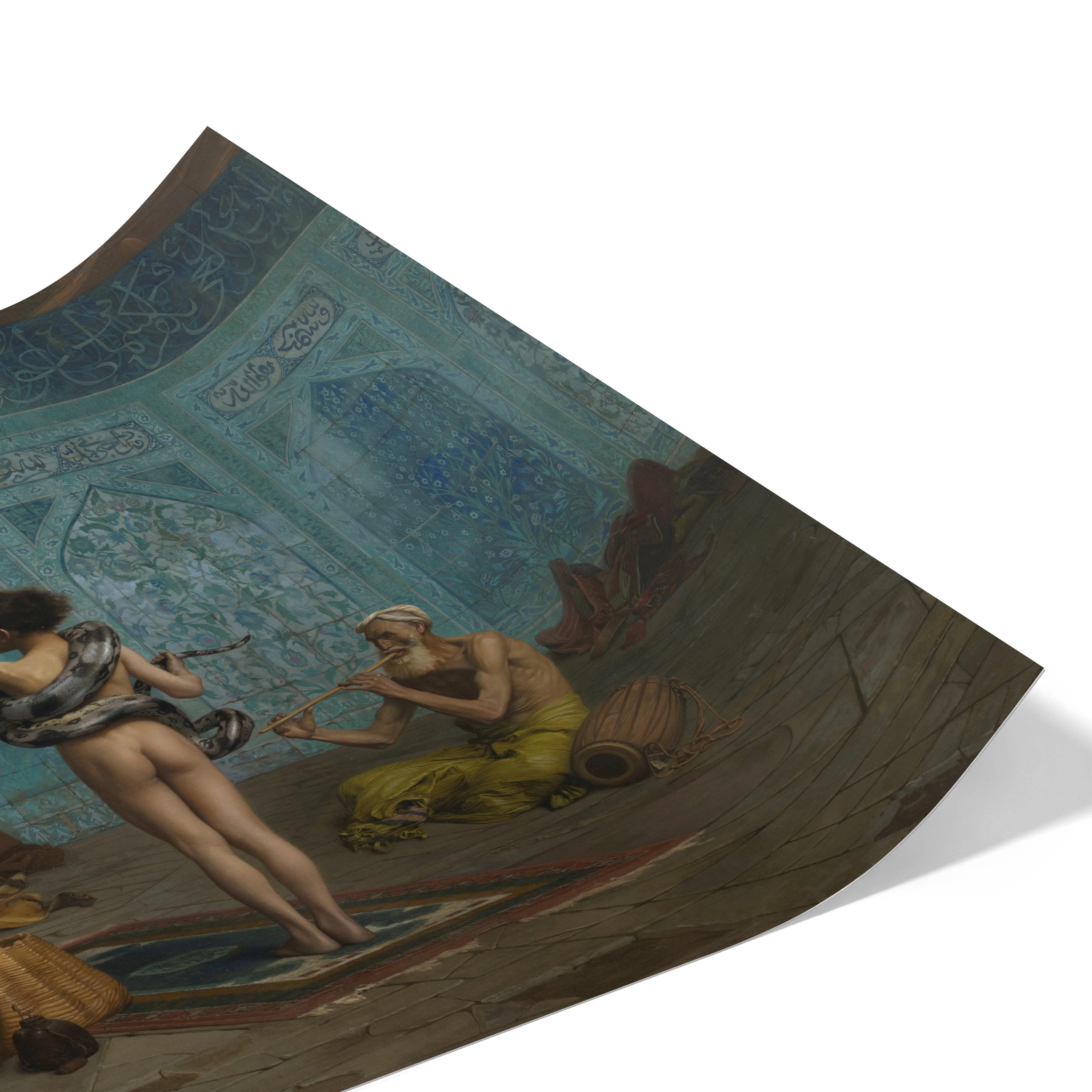
The Snake Charmer | Jean-Léon Gérôme | c. 1879

Product image 1
Product image 2
Product image 3
Product image 4
Product image 5
Product image 6
Product image 7
Product image 8

The Snake Charmer | Jean-Léon Gérôme | c. 1879

The Snake Charmer | Jean-Léon Gérôme | c. 1879

About the artwork:

The Snake Charmer (c. 1879) by Jean-Léon Gérôme is one of the most iconic examples of 19th-century Orientalism, combining technical mastery with a deeply problematic vision of the “exotic East.” The painting shows a young naked boy holding a large serpent before a tiled wall covered in Islamic calligraphy, while a group of men watch in silence. Gérôme’s extraordinary realism—visible in the cold blue tiles, the luminous skin, and the snake’s coiling form—creates an illusion of authenticity that conceals its staged nature. Rather than documenting a real event, the painting constructs a fantasy of the Orient as primitive, sensual, and mysterious. This calculated spectacle, presented to a Western audience, turns a moment of ritual into a scene of voyeurism, revealing how Orientalist art often projected Europe’s desires and fears onto the cultures it claimed to represent.

Select Select Size
Select Frame Options
From $89.35

Original: $297.82

-70%
The Snake Charmer | Jean-Léon Gérôme | c. 1879

$297.82

$89.35

Product Information

Shipping & Returns

Description

About the artwork:
The Snake Charmer (c. 1879) by Jean-Léon Gérôme is one of the most iconic examples of 19th-century Orientalism, combining technical mastery with a deeply problematic vision of the “exotic East.” The painting shows a young naked boy holding a large serpent before a tiled wall covered in Islamic calligraphy, while a group of men watch in silence. Gérôme’s extraordinary realism—visible in the cold blue tiles, the luminous skin, and the snake’s coiling form—creates an illusion of authenticity that conceals its staged nature. Rather than documenting a real event, the painting constructs a fantasy of the Orient as primitive, sensual, and mysterious. This calculated spectacle, presented to a Western audience, turns a moment of ritual into a scene of voyeurism, revealing how Orientalist art often projected Europe’s desires and fears onto the cultures it claimed to represent.